
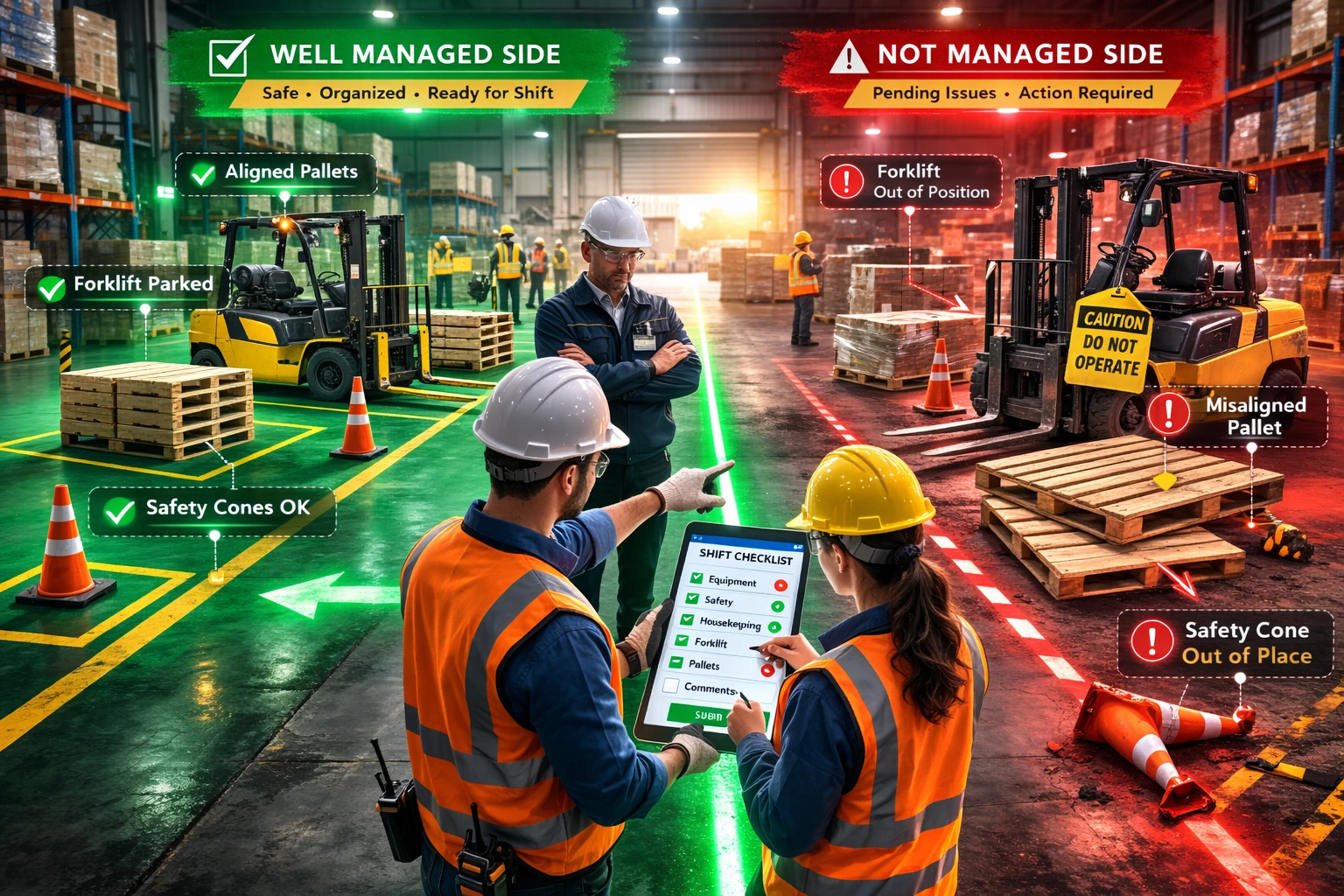
Warehouse Shift Start and End Checklists That Reduce Safety Gaps and Missed Handovers
Warehouse shift routines fail for a simple reason: the operation is optimized for throughput, not for transitions. Shift-start checks are rushed when volume spikes. End-of-shift wrap-up gets compressed. The next crew inherits unresolved problems with incomplete context.
This article lays out a warehouse-focused shift reliability system built around start-of-shift readiness, end-of-shift handoffs, and escalation thresholds.
Why warehouse routines break under throughput pressure
Warehouses create handoff risk when:
- shift-start readiness is treated as optional during busy windows
- end-of-shift tasks are delayed until the final minutes
- equipment issues are noted informally but not escalated
- zone-specific issues are not attached to the right shift/area
- supervisors review after problems repeat
The goal is not more forms. The goal is a control system for shift reliability.
Shift-start checklist components (what protects readiness)
Design shift-start checklists around readiness categories.
Safety readiness
- hazard checks in active zones
- required safety equipment/status checks
- unresolved prior-shift safety escalations acknowledged
Equipment readiness
- critical equipment operational status
- charging/battery readiness where relevant
- maintenance blockers documented/escalated
Operational readiness
- staging/prep area readiness
- staffing/coverage issues affecting workflow
- priority shift instructions acknowledged
This structure helps supervisors quickly see which type of readiness is failing.
Shift-end checklist + handoff structure
End-of-shift routines should preserve continuity, not just mark tasks done.
A warehouse shift-end handoff should include:
- completion status for key shift responsibilities
- blocked/failed items by zone
- equipment status that affects next shift
- safety issues unresolved at handoff
- escalation records requiring supervisor action
This is where a checklist and handoff protocol need to work together. For the broader handoff model, see Shift Handoffs Without the Chaos: A Practical Handoff Workflow for Busy Teams.
Escalation thresholds for safety and equipment issues
Define thresholds so crews are not guessing what belongs in a note vs an escalation.
Examples of escalation-worthy issues:
- safety condition affecting current or next shift operations
- equipment outage reducing workflow capacity
- repeated misses on a critical safety/startup check
- blocker carried across shifts without resolution
Clear thresholds reduce handoff ambiguity and improve supervisor response time.
Supervisor review rhythm (daily vs weekly)
Daily review
- failed/blocked critical checks
- unresolved escalations
- missing proof on selected safety/equipment checks
- repeated misses in the same shift/day
Weekly review
- repeat issues by zone/process
- unrealistic due windows for shift-start/shift-end blocks
- equipment issue patterns by category
- training needs linked to specific missed tasks
Metrics for warehouse shift reliability
Track metrics that reflect transition quality and safety risk:
- on-time completion of shift-start critical checks
- unresolved handoff issues to next shift
- escalation response time
- repeat misses by zone/task
- safety exception frequency by shift
These metrics help you spot structural problems before they become incidents.
Where DoSurely helps warehouse teams
DoSurely supports shift reliability through recurring shift assignments, due timing, notes and escalations, selective proof, and reporting. That combination improves handoff quality and makes review more consistent across supervisors.
Related reading
- Shift Handoffs Without the Chaos: A Practical Handoff Workflow for Busy Teams
- Facilities and Janitorial Teams: Proving Work Was Done Without Slowing Teams Down
- Back to the DoSurely Blog
Book a demo for warehouse shift reliability workflows
If your teams lose time or safety consistency at shift transitions, book a demo and we can help you structure shift-start checks, handoffs, and escalation rules around real warehouse operations.