
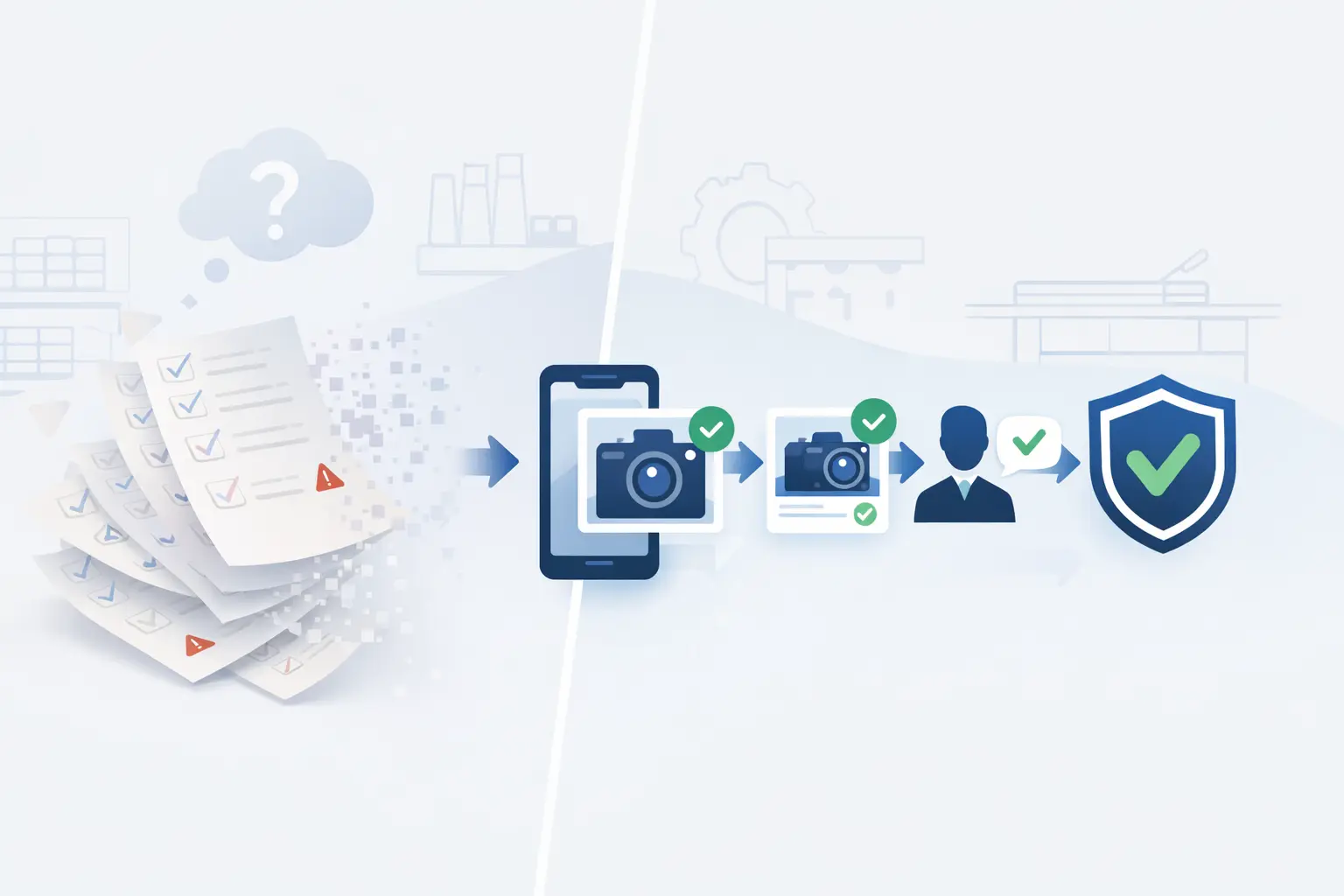
Proof-First Compliance: Why Photos Beat Paper Logs for Daily Ops Checks
Paper logs usually fail in the same way: they record that a check happened, but they do not show what the team actually saw or fixed. When managers review the log later, the only evidence is a signature or a checkbox. That is not enough for high-risk checks, recurring quality issues, or audit scrutiny.
A proof-first compliance workflow solves that problem by attaching evidence where it improves trust and follow-up quality.
The paper-log trust problem
Paper and checkbox-only systems break down when teams need to answer questions like:
- what condition was observed?
- was the issue fixed or just noted?
- did the manager review the evidence?
- is this the same problem happening again?
Without evidence, teams spend time debating what happened instead of fixing the process.
What proof-first means (and what it does not)
Proof-first does not mean taking a photo for every task.
It means:
- identifying tasks where evidence matters
- collecting proof at completion for those tasks
- using proof to support manager review and escalation
- reviewing trends, not just individual incidents
This is a design choice, not a "more documentation" strategy.
Where photo proof adds the most value
High-risk or audit-sensitive checks
If the consequence of failure is high, proof improves trust and review quality.
Frequently disputed checks
If managers, supervisors, or clients often question whether a task was done to standard, proof reduces rework and argument.
Exception handling
Photos are especially useful when a task fails or is blocked and a manager needs context to decide the next action.
Where proof creates unnecessary friction
Proof requirements become harmful when they are applied to low-risk tasks that nobody reviews. Signs of overuse include:
- teams taking low-quality photos just to pass the step
- increased completion time without better outcomes
- managers ignoring proof because the volume is too high
A good rule is to require evidence only when it changes a decision, review, or audit outcome.
A practical proof policy: three levels
Level 1: No proof required
Low-risk routine tasks where completion status is enough.
Level 2: Proof on exception/failure
Evidence required only when the task fails, is blocked, or falls outside standard.
Level 3: Proof required on completion
High-risk, high-visibility, or frequently disputed tasks.
This is usually the best balance between speed and confidence.
Review-at-scale patterns that work
Managers should not review every photo equally. Focus review on:
- missing proof on proof-required tasks
- failed tasks with attached notes/proof
- repeated issues on the same step/location
- pattern shifts (sudden drop in proof compliance)
For facilities-specific execution tradeoffs, see Facilities and Janitorial Teams: Proving Work Was Done Without Slowing Teams Down.
Rollout and measurement guidance
Start with one process, not every checklist in the business.
- choose one high-risk workflow
- define proof-required steps
- train managers on what they will review daily
- measure proof compliance and exception resolution quality
- expand only after review load stays manageable
Where DoSurely fits
DoSurely supports proof-first compliance by combining checklists, proof capture, due timing, notes, escalations, and reporting in one workflow. That makes evidence part of execution instead of a separate audit exercise.
Related reading
- Facilities and Janitorial Teams: Proving Work Was Done Without Slowing Teams Down
- How Multi-Location Restaurants Keep Standards Consistent Across Every Store
- Back to the DoSurely Blog
Book a demo to design a proof-first workflow
If you want stronger audit confidence without slowing teams down, book a demo and we can help you define where proof belongs and how managers should review it.